
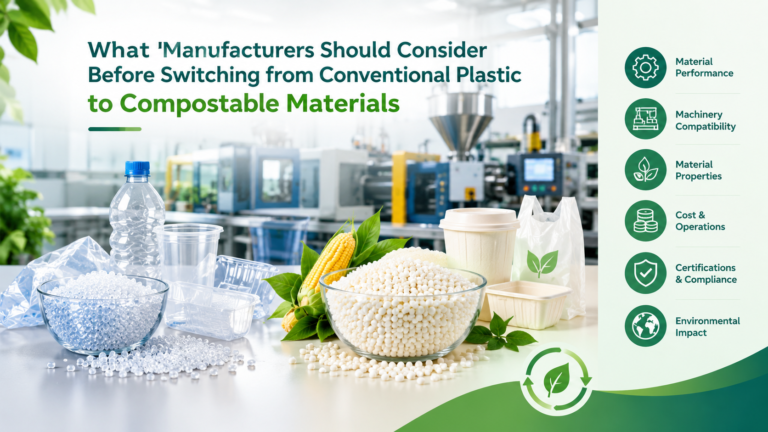
The decision to transition an industrial manufacturing line from conventional petrochemical plastics to compostable materials is a milestone moment for any enterprise. Driven by shifting consumer preferences, impending regulatory bans on single-use plastics, and corporate ESG (Environmental, Social, and Governance) commitments, companies across the globe are re-evaluating their material portfolios. However, transitioning from synthetic polymers that endure for centuries to materials designed to return safely to the earth is a complex engineering and operational undertaking. Success requires careful strategic planning, thorough technical evaluation, and a clear understanding of supply chain realities.
Defining Compostability: Industrial vs. Home Composting Standards
One of the most critical preliminary considerations for manufacturers is understanding the precise end-of-life mechanism required for their products. Compostable materials are not a monolithic category; they are strictly engineered to degrade under specific biological conditions governed by international standards such as ASTM D6400 or EN 13432.
Production leaders must evaluate whether their target market has access to industrial composting infrastructure or if home-compostable formulations are necessary. Industrial compostable resins typically require controlled temperatures, moisture levels, and microbial activity found in municipal composting facilities, whereas home-compostable variants degrade safely in backyard compost bins. Misaligning the product’s end-of-life specification with regional waste management infrastructure can lead to consumer confusion and policy non-compliance.
Mechanical and Thermal Performance Compatibility
Conventional plastics like polyethylene, polypropylene, and polystyrene were optimized over decades to possess specific tensile strengths, impact resistance, and thermal thresholds. When substituting these with compostable biopolymers such as PLA blends or PHA, manufacturers must rigorously test mechanical compatibility.
Factors such as tensile elongation, heat deflection temperature, moisture barrier properties, and seal integrity under high-speed packaging lines must be analyzed. Expert partners like Deltora Biopolymers Pvt. Ltd. assist manufacturers in conducting thorough laboratory testing and pilot trials to ensure compostable compounds meet or exceed the performance benchmarks of legacy plastics without requiring complete overhauls of existing machinery.
Supply Chain Resilience and Raw Material Sourcing
Unlike petroleum derivatives derived from global oil refining networks, bio-based feedstocks are tied to agricultural yields, fermentation capacities, and regional biomass availability. Manufacturers must examine the resilience and traceability of their raw material supply chains before committing to large-scale production runs.
Evaluating supplier reliability, batch-to-batch consistency, and long-term price stability is essential. Partnering with established compounders like Deltora Biopolymers Pvt. Ltd. guarantees access to rigorously tested, high-grade compostable resins backed by robust quality assurance protocols, minimizing production downtime and mitigating supply chain vulnerabilities.
Regulatory Landscape and Certification Compliance
The sustainability claims made by manufacturing brands face intense scrutiny from regulatory bodies and consumer protection agencies worldwide. Greenwashing allegations carry severe financial and reputational penalties. Therefore, obtaining certified compostability credentials from accredited third-party laboratories is non-negotiable.
Manufacturers must ensure that their finished goods comply with regional labeling laws, heavy metal limits, and ecotoxicity testing. Designing packaging or manufactured goods with certified resins simplifies the regulatory approval process and builds unshakeable trust with eco-conscious consumers.
Cost Analysis and Total Value Assessment
A common hesitation among production managers is the initial material cost disparity between commodity plastics and specialized compostable resins. While raw material purchase costs for biopolymers may currently be higher due to scaling economics, a comprehensive total cost of ownership (TCO) evaluation reveals hidden savings.
Reduced extended producer responsibility (EPR) fees, avoidance of plastic packaging taxes, enhanced brand loyalty, and future-proofing against incoming regulatory bans all contribute to a favorable long-term financial ROI. Transitioning to compostable materials is an investment in business resilience.
Conclusion: A Strategic Roadmap for Sustainable Production
Switching to compostable materials is far more than a simple procurement swap; it is a holistic corporate evolution. By meticulously assessing performance metrics, infrastructure readiness, regulatory requirements, and supply chain partners, manufacturers can execute a seamless transition.
Embracing compostable innovation positions forward-thinking companies at the forefront of the modern green economy, transforming environmental responsibility into a lasting competitive advantage.