
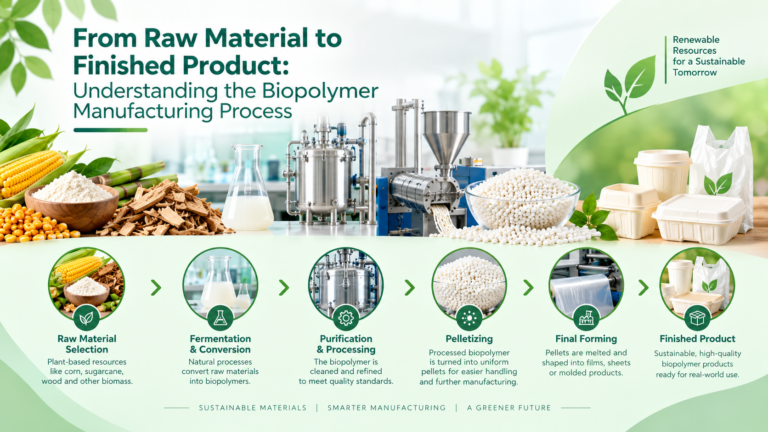
The journey of a biopolymer from an agricultural field or microbial fermenter to a precision-engineered finished product is a masterclass in modern chemical and material engineering. While traditional plastics rely on the fractional distillation of crude oil, biopolymers harness the intricate molecular structures found in nature and refine them through advanced industrial processes. Understanding this complex manufacturing journey is essential for engineers, product designers, and sustainability officers seeking to leverage bio-based materials effectively in their commercial operations.
Step 1: Feedstock Extraction and Biomass Selection
The biopolymer manufacturing process begins with the careful selection and harvesting of renewable biomass. Depending on the desired polymer family, feedstocks can range from starch-rich crops like corn, tapioca, and potatoes to non-food lignocellulosic biomass, agricultural waste streams, and sugars fermented by specific bacteria.
The primary objective during extraction is to isolate high-purity carbohydrates, cellulose chains, or polyhydroxyalkanoates. This stage requires rigorous quality control to ensure that moisture content, impurities, and chemical compositions remain within strict tolerances before the material enters primary chemical conversion phases.
Step 2: Polymerization and Chemical Transformation
Once pure feedstocks or intermediary monomers—such as lactic acid derived from corn dextrose fermentation—are obtained, they undergo polymerization. In this critical phase, smaller monomer molecules are chemically bonded into long, repeating polymer chains under controlled heat, pressure, and catalysis.
For instance, in the production of Polylactic Acid (PLA), lactic acid molecules are first condensed into a low-molecular-weight prepolymer and then catalytically converted into a high-molecular-weight lactide ring, which is subsequently ring-opened polymerized. This delicate chemical ballet determines the intrinsic viscosity, molecular weight distribution, and baseline mechanical properties of the resulting resin.
Step 3: Compounding and Additive Engineering
Raw, uncompounded biopolymers often exhibit limitations in flexibility, brittleness, heat resistance, or processing speeds. To bridge this gap, advanced compounders utilize state-of-the-art twin-screw compounding extruders to blend base resins with specialized natural plasticizers, nucleating agents, biodegradable fillers, and functional additives.
Industry leaders like Deltora Biopolymers Pvt. Ltd. excel in this exact phase, formulating proprietary masterbatches and custom resin compounds tailored to specific industrial processing requirements. Through precise thermal profiling and high-shear mixing, additives are homogeneously dispersed throughout the polymer matrix, optimizing elongation at break, impact resistance, and melt flow index.
Step 4: Pelletization and Quality Assurance
Following successful compounding, the molten polymer strand is extruded through cooling water baths, solidified, and precision-cut into uniform pellets. These pellets represent the standardized commercial form sold to converters and manufacturers.
Before packaging and shipping, rigorous quality assurance protocols are executed. Batches undergo laboratory testing for melt flow rate (MFR), tensile strength, moisture content, and thermal degradation thresholds. Ensuring absolute batch consistency is vital for preventing factory floor disruptions during subsequent injection molding or film blowing operations.
Step 5: Conversion into Finished Goods
The final phase of the manufacturing lifecycle takes place on the customer’s production floor. Biopolymer pellets are fed into conventional conversion machinery—including injection molders, blown-film extruders, thermoformers, and 3D printers.
Because specialized biopolymer compounds are engineered to mimic the processing behavior of traditional plastics, operators can often utilize existing tooling and machinery with minimal parameter adjustments. Whether forming rigid consumer electronics housings, flexible agricultural mulch films, or intricate cosmetic jars, the final product emerges ready to serve its purpose before eventually returning safely to biological cycles.
Conclusion: The Synergy of Nature and Engineering
The biopolymer manufacturing process bridges the wisdom of natural biological systems with the precision of modern polymer engineering. By optimizing each stage—from biomass extraction to advanced compounding—industries can achieve superior product performance without compromising ecological health.
Collaborations with expert compounders like Deltora Biopolymers Pvt. Ltd. ensure that manufacturers receive finely tuned materials designed to thrive in real-world production environments, paving the way for a fully sustainable industrial future.