
Introduction
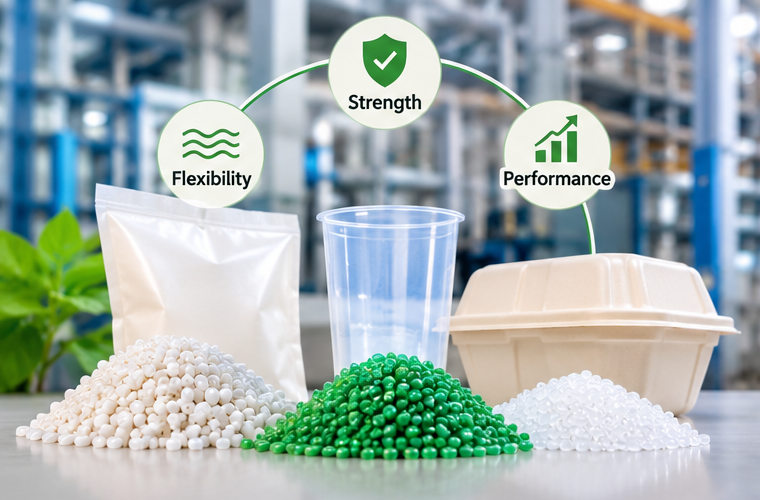
Industrial manufacturers need materials that can meet demanding performance requirements while supporting more responsible material choices. Biopolymers offer opportunities to reduce dependence on conventional fossil-based plastics, but a single polymer rarely delivers every property required by a finished product. Some grades may be stiff but brittle, while others provide flexibility but need improved strength or processability. Biopolymer blending addresses this challenge by combining selected polymers, additives and, where suitable, natural fillers to create a material with a more balanced performance profile.
What Is a Biopolymer Blend?
A biopolymer blend is a material system made by combining two or more polymer components. The components may be bio-based, biodegradable or compostable, but these terms are not interchangeable. Bio-based describes the origin of a material; biodegradable describes its ability to break down through biological activity under specified conditions; and compostable refers to meeting defined breakdown and disintegration requirements in a particular composting environment. A blend must be evaluated as a complete formulation rather than judged only by the properties of its individual ingredients.
Why Blending Matters
Different applications place different demands on materials. A thin packaging film may need tear resistance, flexibility, sealing performance and reliable conversion on a blown-film line. A molded item may require rigidity, dimensional stability and resistance to impact during handling. A thermoformed tray may need a suitable balance of stiffness, clarity and heat performance. Blending allows formulators to adjust these characteristics by selecting compatible polymer combinations and controlling their proportions. The goal is not simply to add more ingredients, but to design a material around the product’s actual operating conditions.
Improving Strength and Toughness
Strength and toughness are related but distinct properties. Tensile strength indicates how much stress a material can withstand while being stretched, whereas toughness describes its ability to absorb energy before failure. A blend may improve one property while affecting another, so formulation work requires testing across several measures. Polymer compatibility, molecular structure, dispersion and processing history all influence the final result. Compatibilizers or other functional additives may help improve interactions between phases in selected systems, but their suitability must be confirmed through controlled trials.
Creating the Right Flexibility
Flexibility is especially important for films, liners, bags and products that must bend or fold without cracking. Formulators can tune flexibility through polymer selection, blend ratios and carefully chosen modifiers. The right balance depends on the intended thickness, temperature range, load and service life. Too much flexibility can make a product difficult to handle or reduce its dimensional stability; too little can lead to brittle failure. Manufacturers should therefore define practical acceptance criteria before selecting a formulation.
Processing Performance on Production Lines
A successful compound must perform not only in a laboratory test but also on the customer’s manufacturing equipment. Melt flow, thermal stability, moisture sensitivity and cooling behavior can influence extrusion, injection molding and thermoforming. A blend that has excellent mechanical properties may still be unsuitable if it causes unstable output, poor surface finish or inconsistent dimensions. This is why pilot-scale processing is important. Operators should record melt temperatures, screw speed, throughput, cooling conditions and any signs of degradation, then compare the results with the control material.
Testing and Quality Control
A structured testing plan may include tensile strength, elongation at break, impact resistance, melt flow rate, density, thermal analysis and application-specific tests. Film producers may also assess puncture resistance, tear behavior, sealing strength and thickness variation. Molded-product manufacturers may check dimensional accuracy, warpage and impact performance. Testing should use recognized methods and consistent sample conditioning. Results should be reviewed alongside production observations so that the formulation is judged on its complete performance, not on one headline value.
Sustainability Must Be Evaluated Carefully
Blending does not automatically make a material biodegradable or compostable. The complete formulation—including polymer components, fillers, pigments and additives—must meet the relevant requirements for the claim being made. End-of-life conditions also matter: industrial composting, home composting, soil and marine environments are different settings. Manufacturers should obtain appropriate test reports and certification evidence before making environmental claims. Clear disposal instructions help prevent compostable products from being mixed into unsuitable waste streams.
Working with a Material Development Partner
Developing a fit-for-purpose blend is a collaborative process. Product designers understand the function and appearance required, converters understand machine behavior, and compounders bring formulation and material-testing knowledge. Deltora Biopolymers Private Limited describes its work in compostable compounds, customized formulations and research-led material development. Early sharing of product drawings, target properties, processing details and expected volumes can help shorten development cycles and reduce trial-and-error.
Conclusion
Biopolymer blends can help manufacturers balance strength, flexibility and processability for specific industrial applications. The most reliable results come from a disciplined approach: define the product requirements, choose suitable polymer systems, compound under controlled conditions, validate processing performance and test the finished material. Environmental claims should be based on the complete formulation and verified end-of-life conditions. For a broader overview of the stages involved, read the related guide, “From Raw Material to Finished Product: Understanding the Biopolymer Manufacturing Process.”