
Introduction
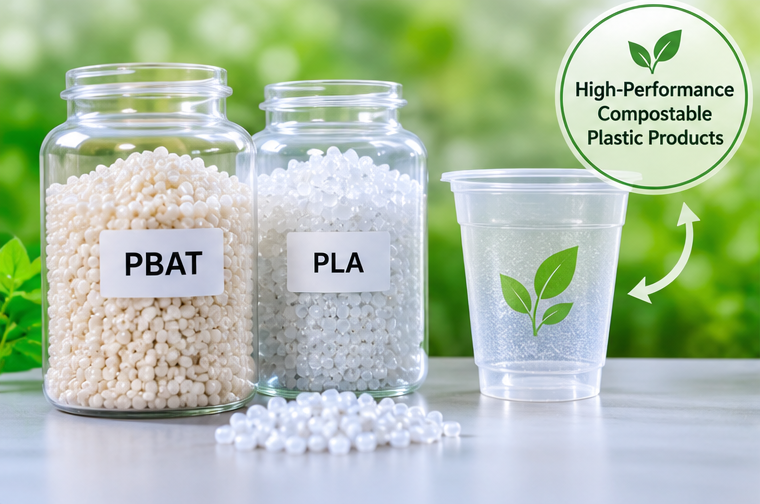
PBAT and PLA are two polymers frequently discussed in the development of compostable plastic products. They offer different characteristics, which can make them useful components in a carefully designed blend. PLA is generally valued for stiffness, clarity in selected grades and its thermoplastic processing potential. PBAT is commonly used to contribute flexibility and toughness. Combining them can help formulators create materials for applications such as flexible films and bags, but compatibility and performance depend on grade selection, blend design, additives and processing conditions.
Getting to Know PLA
Polylactic acid, commonly known as PLA, is a thermoplastic polyester typically produced from lactic acid derived through fermentation of carbohydrate feedstocks. Depending on grade and processing history, PLA can offer good stiffness and strength. It is used in applications such as packaging, thermoformed items and molded products. However, some PLA grades can be relatively brittle, and their heat resistance and processing window may require attention. Moisture control is important because hydrolytic degradation can reduce molecular weight during melt processing.
Getting to Know PBAT
Polybutylene adipate terephthalate, or PBAT, is a flexible aliphatic-aromatic copolyester used in applications where ductility and film performance are important. It can contribute elongation and toughness to a blend. PBAT is fossil-derived in many commercial grades, so it should not automatically be described as bio-based. Its biodegradability and compostability claims depend on the grade, formulation, test conditions and applicable certification. This distinction is important when communicating the environmental profile of a finished product.
Why Combine the Two?
The central reason for blending PLA and PBAT is to balance properties. PLA can contribute stiffness and strength, while PBAT can improve flexibility and resistance to tearing or impact. The final result is not a simple average of the two materials. Polymer morphology, phase distribution, interfacial adhesion and processing history all influence behavior. A blend that performs well for a flexible film may not be suitable for a rigid molded product. The intended application should therefore guide the formulation from the beginning.
Compatibility and Compatibilization
Many polymer pairs do not mix uniformly at the molecular level. In an immiscible blend, separate phases may form, and weak interaction between them can lead to poor mechanical performance. Compatibilizers or reactive additives may help improve interfacial adhesion in selected systems. Their selection and dosage require experimentation because an additive that improves one property may affect melt flow, color, cost or compostability. Microscopy, mechanical testing and processing trials can help determine whether the blend structure is delivering the intended result.
Processing Considerations
PBAT and PLA blends are typically processed using extrusion-based compounding followed by film extrusion, injection molding or other conversion methods, depending on the formulation. Temperature profile, screw configuration, residence time, shear and moisture content can influence the material. Excessive heat or prolonged residence time may cause degradation. Inadequate mixing can produce inconsistent properties, while excessive shear may also affect polymer structure. Converters should follow grade-specific supplier recommendations and validate conditions on their own equipment.
Testing the Finished Product
A reliable evaluation includes more than tensile strength. For film applications, manufacturers may measure elongation, tear resistance, puncture resistance, sealing behavior, thickness consistency and dart impact. For molded products, impact strength, dimensional stability, surface finish and heat behavior may be more relevant. Melt flow rate and thermal analysis can help monitor material consistency. Compostability testing must be performed on the final formulation or product as required by the relevant standard; certification of one raw material does not automatically certify every blend or finished item.
Choosing the Right Application
PLA/PBAT blends may be considered for compostable bags, flexible packaging and other products where a balance of stiffness and flexibility is needed. The formulation must match the product’s service conditions, including load, temperature, storage period and expected handling. Food-contact applications require separate regulatory and migration assessments. Products intended for industrial composting should carry accurate disposal information and be directed to facilities that accept them. Claims should be specific and supported by valid documentation.
Development and Supplier Collaboration
Successful development depends on communication between resin suppliers, compounders, film producers, product designers and testing laboratories. Share the target thickness, machine type, output rate, required mechanical properties and intended end-of-life route before selecting a grade. Deltora Biopolymers Private Limited works in compostable compounds and customized material development, which are relevant areas when manufacturers evaluate formulation options. Request current technical data and certificates for the exact grade under consideration, then conduct production-scale validation.
Conclusion
PBAT and PLA can complement each other in selected compostable product formulations: PLA can contribute stiffness, while PBAT can add flexibility and toughness. However, compatibility, processing stability and end-of-life performance must be demonstrated for the complete blend. A disciplined development process—starting with application requirements and ending with production and compostability validation—helps manufacturers avoid assumptions and create products that meet both functional and environmental expectations. For a wider look at biopolymer applications in manufacturing, read “How Biopolymers Are Changing the Way Everyday Products Are Manufactured.”