
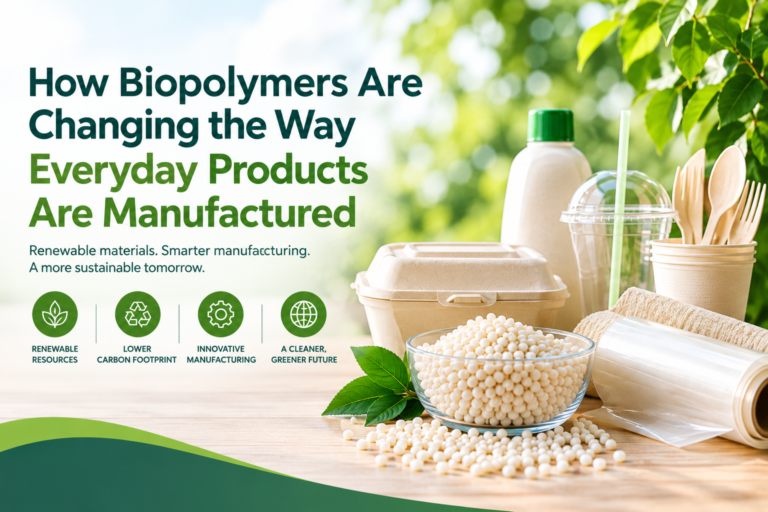
The modern manufacturing landscape is undergoing a silent yet profound metamorphosis. For decades, traditional petroleum-based plastics have served as the foundational building blocks for thousands of consumer and industrial goods, ranging from packaging films to automotive components. However, mounting ecological pressures, depleting fossil fuel reserves, and stricter global regulations have illuminated the severe limitations of linear ‘take-make-dispose’ economic models. Enter biopolymers—a revolutionary class of materials derived from renewable biomass sources such as corn starch, sugarcane, cellulose, and microbial fermentation. These materials are not merely alternative substitutes; they represent a fundamental paradigm shift in how everyday items are conceived, engineered, produced, and decommissioned.
The Imperative Shift Beyond Petrochemical Plastics
Petrochemical plastics have long dominated manufacturing due to their low cost, versatility, and durability. Yet, their persistence in natural ecosystems for centuries poses an unprecedented environmental crisis. Biopolymers challenge this dominance by offering functional performance profiles that match conventional plastics while degrading safely under appropriate composting conditions or returning nutrients back to biological cycles.
Industrial designers and production engineers are no longer asking whether biopolymers can replace traditional polymers, but rather how quickly supply chains can adapt to integrate them. From consumer electronics casings to single-use food service packaging, biopolymers eliminate the burden of perpetual waste accumulation. Forward-thinking enterprises recognize that aligning product lines with regenerative material science is essential for long-term brand equity and regulatory compliance.
Redesigning Production Lines for Bio-Based Resins
Transitioning manufacturing lines from petrochemical plastics to biopolymers is not a simple drop-in replacement; it requires a nuanced understanding of material rheology, thermal stability, and processing behavior. Biopolymers such as Polylactic Acid (PLA), Polyhydroxyalkanoates (PHA), and thermoplastic starch possess distinct processing windows compared to polypropylene or polyethylene. Equipment calibration, temperature profiles, and mold designs must be meticulously optimized to prevent thermal degradation and ensure structural integrity.
Pioneers in this field, such as Deltora Biopolymers Pvt. Ltd., work closely with industrial manufacturers to bridge the gap between polymer science and factory floor execution. By providing customized compound formulations and technical guidance, these material innovators ensure that processing machinery runs efficiently without sacrificing cycle times or mechanical specifications.
Applications Across Diverse Consumer Sectors
The versatility of biopolymers has unlocked innovative design possibilities across multiple industries. In the packaging sector, flexible films and rigid containers made from bio-polymers protect perishable goods while drastically reducing carbon footprints. In agriculture, biodegradable mulches and seedling pots eliminate the labor-intensive removal of plastic debris from fields, naturally degrading into harmless organic compounds after use.
Furthermore, the automotive and electronics industries are increasingly adopting bio-composites reinforced with natural fibers like hemp, flax, or jute combined with biopolymer matrices. These advanced materials offer lightweight properties that improve fuel efficiency in vehicles while satisfying stringent corporate sustainability mandates.
Navigating Cost, Scalability, and Performance
While the ecological advantages of biopolymers are undeniable, widespread industrial adoption hinges on balancing cost competitiveness with high performance. Historically, specialty bio-resins carried a significant price premium over commodity plastics. However, economies of scale, technological advancements in fermentation and extraction, and rising carbon taxes are rapidly narrowing this economic gap.
As global production capacities expand, the cost per kilogram of high-performance biopolymers continues to stabilize. Manufacturers who invest in bio-based manufacturing early position themselves ahead of regulatory curves, insulating their operations against the volatility of fossil fuel markets.
The Road Ahead: Building a Regenerative Economy
The transformation of everyday manufacturing through biopolymers signals a broader transition toward a circular, regenerative economy. By closing the loop between material extraction, product lifecycle, and organic return, industries can decouple economic growth from environmental degradation.
Strategic collaborations between polymer chemists, equipment manufacturers, and brand owners—exemplified by the dedicated research and development initiatives at Deltora Biopolymers Pvt. Ltd.—are accelerating this transition. Ultimately, biopolymers are redefining not just how products are made, but what it means to manufacture responsibly in the twenty-first century.