
1.Introduction
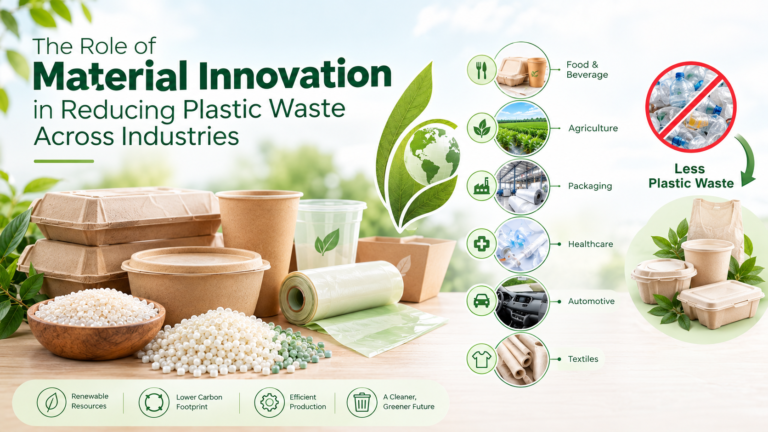
Plastic materials have helped make products lighter, more durable, and more affordable, but the way many plastic items are designed, used, and discarded creates a substantial waste-management challenge. Material innovation can help address this issue by improving product design, reducing unnecessary material use, and creating alternatives suited to specific applications. No single material can solve every waste problem. Progress depends on matching material choices with product needs, collection systems, and responsible end-of-life management.
2.Design products to use resources more carefully
One of the most direct ways to reduce waste is to avoid using more material than a product needs. Designers can review wall thickness, packaging dimensions, protective inserts, and unnecessary layers while maintaining performance. Lightweighting may reduce raw-material demand and transport weight, but it must not compromise product protection or increase damage and returns. A lighter package that causes more breakage may create a worse overall outcome.
Material innovation supports this work through improved formulations, better barrier properties, and compounds tailored to specific functions. Teams should test the entire packaging system, including seals, labels, inks, adhesives, and secondary packaging. Small design improvements across high-volume product lines can make a meaningful difference over time.
3.Explore alternatives suited to each application
Biopolymers and other alternative materials can be useful options in selected applications. Some are derived partly or wholly from renewable feedstocks; others are designed to biodegrade or meet compostability standards under defined conditions. These characteristics are not interchangeable. A bio-based material is not automatically biodegradable, and a biodegradable product does not necessarily break down rapidly in every natural environment.
Potential uses include selected films, bags, trays, molded items, and agricultural products, depending on the material grade and required performance. Manufacturers should assess strength, flexibility, moisture resistance, heat tolerance, shelf life, and processing needs before choosing an alternative. Testing the finished product is essential because additives, thickness, coatings, and manufacturing conditions can influence how it performs and how it is managed after use.
4.Build waste prevention into manufacturing
Waste reduction is not limited to the finished product. Production teams can examine start-up scrap, off-spec batches, trimming losses, packaging waste, and energy-intensive rework. Better process control, preventive maintenance, operator training, and accurate material handling can reduce losses regardless of the polymer being processed. Where safe and technically suitable, manufacturers may evaluate whether clean production scrap can be recovered or reused without harming product quality or regulatory compliance.
Material suppliers and processors can collaborate on formulations that fit existing equipment and reduce avoidable process difficulties. Pilot runs, documented settings, and routine quality checks help identify whether a new material performs consistently. These measures make it easier to evaluate the real environmental and financial impact of a material change rather than relying on a single sustainability claim.
5.Think beyond the material label
A responsible comparison considers the full product life cycle. Feedstock sourcing, manufacturing energy, transportation, product durability, reuse potential, and disposal all affect environmental performance. A compostable item may offer benefits in a suitable collection and composting system, but those benefits can be limited if it is sent to a facility that cannot process it. Similarly, recyclable packaging creates value only when collection, sorting, and recycling systems can handle it effectively.
Businesses should therefore map the likely journey of a product after use. Identify whether customers can separate it from other waste, whether local facilities accept it, and whether clear labeling is needed. Environmental claims should be specific, evidence-based, and understandable. Avoid suggesting that any alternative material is impact-free or that it will disappear under all conditions.
6.Encourage cooperation across the supply chain
Waste prevention requires coordinated decisions. Brand owners set product requirements, designers choose formats, manufacturers select materials and processing methods, retailers influence packaging needs, and waste operators manage discarded products. When these groups share information early, they can avoid incompatible materials, confusing disposal instructions, and packaging that is difficult to recover.
Useful steps include setting measurable waste targets, reviewing packaging formats periodically, collecting customer feedback, and tracking scrap and damage rates. Businesses can also compare supplier documentation and request relevant test reports. The goal is to make decisions based on evidence and real operating conditions, not only on marketing language.
7.Conclusion
Material innovation is most effective when it forms part of a wider waste-reduction strategy. Better design, efficient production, fit-for-purpose alternative materials, clear disposal information, and suitable collection infrastructure all play a role. Companies should evaluate each product individually and measure results after implementation. For more context on emerging material options, read Sustainable Biopolymer Innovations: Building a Greener Future for Packaging and Beyond. Deltora Biopolymers Private Limited provides information about compostable material solutions that businesses can assess as part of their own technical and environmental evaluation.