
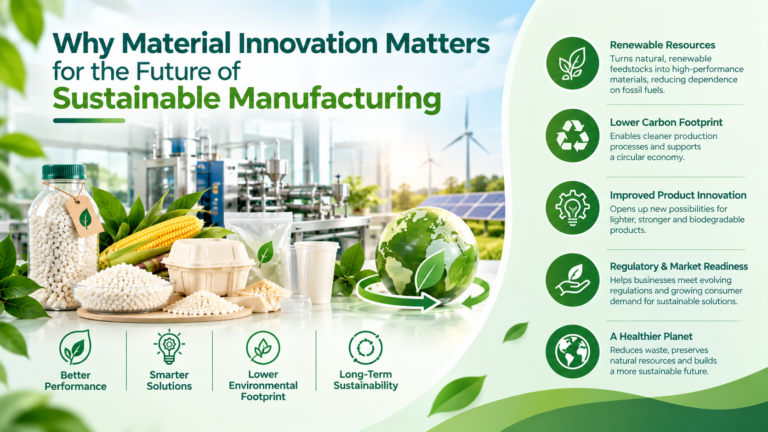
In the grand architecture of global industry, materials are the fundamental bedrock. Every automobile on the highway, every medical device in a hospital, every electronic gadget in our pockets, and every piece of packaging on supermarket shelves owes its existence to material science. For over a century, progress was defined by our ability to synthesize durable, low-cost synthetic materials primarily sourced from petrochemicals. Today, however, humanity faces an inescapable ecological reckoning. As resource depletion and plastic pollution threaten planetary boundaries, it has become abundantly clear that the future of industry cannot be built on yesterday’s materials. Material innovation is no longer just a specialized research discipline; it is the ultimate engine driving the future of sustainable manufacturing.
Moving Beyond the Limits of Linear Material Models
Traditional manufacturing has long operated on a linear ‘take, make, waste’ framework. Raw fossil resources are extracted, processed into single-use or short-lifecycle products, and ultimately discarded into landfills or natural ecosystems. This model is fundamentally unsustainable in a finite world with an expanding global population.
Sustainable manufacturing demands a circular paradigm where materials are either endlessly recyclable or entirely biodegradable, returning harmlessly to biological or technical nutrient streams. Material innovation provides the key to unlocking this circularity. By engineering polymers that interact harmoniously with natural ecosystems, scientists and engineers are dismantling the necessity of permanent synthetic waste.
The Intersection of High Performance and Eco-Consciousness
A persistent myth in industrial circles is that sustainable materials require a compromise in performance, durability, or cost-efficiency. Early attempts at green packaging or bio-based goods often suffered from brittleness, moisture sensitivity, or poor thermal stability, alienating commercial manufacturers accustomed to robust petrochemical plastics.
Modern material science has shattered these limitations. Through advanced molecular design, nanotechnology, and sophisticated bio-compounding techniques, today’s advanced biopolymers match or exceed the mechanical properties of conventional plastics. They offer exceptional tensile strength, barrier protection, clarity, and heat resistance. Innovation ensures that going green does not mean lowering industry standards.
Catalyzing Industry Standards and Global Regulations
Governments worldwide are accelerating legislative crackdowns on single-use plastics and imposing stringent extended producer responsibility (EPR) mandates. Carbon taxes and landfill bans are rapidly transforming environmental compliance from an optional corporate PR initiative into an urgent financial imperative.
In this high-stakes regulatory environment, companies that rely solely on legacy materials face severe compliance risks and escalating operational costs. Conversely, enterprises that embrace material innovation proactively adapt to regulatory shifts, securing market share, avoiding penalties, and positioning themselves as trusted industry leaders.
Collaborative Ecosystems: Bridging Lab Science to Factory Floors
The journey from a breakthrough in a polymer chemistry laboratory to a scalable, high-speed industrial manufacturing line is fraught with technical and commercial hurdles. No single entity can navigate this complex ecosystem alone. Success requires deep collaboration across academic researchers, polymer chemists, equipment manufacturers, and brand owners.
Industry pioneers such as Deltora Biopolymers Pvt. Ltd. play a vital catalyst role in this collaborative web. By translating complex scientific formulations into scalable, factory-ready compounds, they empower manufacturers to adopt cutting-edge sustainable materials without disrupting existing production efficiencies or sacrificing output.
Economic Resilience and Long-Term Brand Equity
Beyond ecological preservation and regulatory compliance, material innovation unlocks powerful commercial advantages. Consumers today are increasingly discerning, voting with their wallets for brands that demonstrate authentic, transparent commitments to sustainability. Greenwashing is easily detected, whereas genuine material innovation builds profound, lasting brand loyalty.
Furthermore, as fossil fuel markets remain notoriously volatile, decoupling supply chains from crude oil through renewable bio-based polymers provides long-term price stability and economic insulation for progressive manufacturers.
Conclusion: Engineering a Regenerative Tomorrow
Material innovation is the beating heart of the sustainable manufacturing revolution. By reimagining the molecular foundations of our everyday products, we possess the power to transform industry from a driver of environmental degradation into a force for planetary regeneration.
As organizations like Deltora Biopolymers Pvt. Ltd. continue to push the boundaries of bio-based material science, the vision of a truly circular industrial economy moves closer to reality. The future belongs to those who innovate not just what they make, but what they make it with.