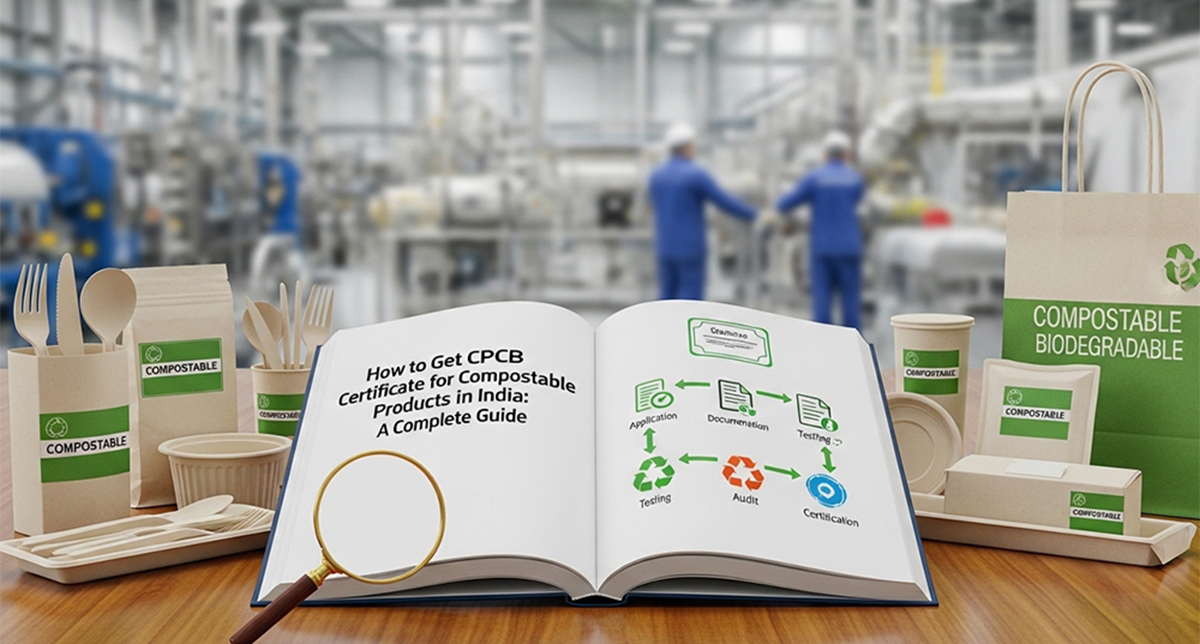
How to Get CPCB Certificate for Compostable Products in India A Complete Guide

With the growing demand for sustainable packaging and eco-friendly alternatives, obtaining a CPCB Certificate for Compostable Products has become essential for manufacturers and sellers in India. As per the Plastic Waste Management Rules, compostable plastic products must be approved by the Central Pollution Control Board before they can be legally manufactured, marketed, or sold.

For businesses entering the biodegradable and compostable products sector, the CPCB Certificate for Compostable items not only ensures legal compliance but also builds trust among buyers, distributors, and regulatory authorities.

Table of Contents

1. What is CPCB Certification?

The Central Pollution Control Board (CPCB) is India’s apex authority for environmental regulation. The CPCB Certificate for Compostable Products confirms that a material meets compostability standards such as IS/ISO 17088 and can decompose without leaving harmful residues.

  • Compostable carry bags
  • Packaging films
  • Disposable cutlery
  • Compostable pouches
  • Food packaging items
  • Agricultural mulch films

2. Why CPCB Certificate is Mandatory

  • Legal Compliance: Required under Plastic Waste Management Rules
  • Prevention of False Claims: Avoid misleading sustainability claims
  • Quality Validation: Ensures compostability standards
  • Market Trust: Improves customer confidence
  • Sales Approval: Required for manufacturing and selling

3. Step-by-Step Process to Get Certification

Step 1: Product Testing

  • Biodegradability
  • Compostability
  • Heavy metal limits
  • Disintegration time
  • Toxic residue check

Step 2: Obtain SPCB / PCC Consent

  • Consent to Establish (CTE)
  • Consent to Operate (CTO)

Step 3: Prepare Documentation

Compile all business and technical documents.

Step 4: Apply on CPCB Portal

Submit application online with all required documents and reports.

Step 5: Certificate Approval

After approval, CPCB issues a certificate number which must be printed on packaging along with QR code and “COMPOSTABLE” label.

4. Documents Required

  • Company registration certificate
  • GST certificate
  • PAN card
  • Factory license
  • SPCB consent certificates
  • Product test report
  • Manufacturing flow chart
  • Raw material details
  • Plant photographs
  • Packaging label design
  • Authorization letter

5. Important Compliance Guidelines

  • Print certificate number on products
  • Add QR code for traceability
  • Use “COMPOSTABLE” label
  • Submit six-monthly reports
  • Maintain production records

6. Common Mistakes to Avoid

  • Incomplete test reports
  • Missing SPCB approvals
  • Incorrect labeling
  • False compostable claims
  • Delayed compliance reporting

7. Conclusion

Obtaining a CPCB Certificate for Compostable Products is essential for businesses producing sustainable plastic alternatives in India. It ensures compliance, enhances brand credibility, and opens new market opportunities.

8. FAQs

  1. Is CPCB certification mandatory?
    Yes, it is required before selling compostable products.
  2. Which standard is used?
    IS/ISO 17088 is commonly used.
  3. How long does approval take?
    Usually a few weeks to months.
  4. Do sellers need certification?
    Yes, depending on their role.
  5. What if products are sold without certification?
    Legal action and penalties may apply.
How to Get Biodegradability Certificate in India A Complete Guide

As environmental regulations in India continue to evolve, manufacturers and sellers are increasingly focusing on sustainable and eco-friendly materials. Obtaining a Biodegradability Certificate has become an important step for businesses involved in biodegradable plastic products, packaging films, carry bags, and related materials. This certification helps verify that the product can break down naturally under specified conditions and complies with applicable Indian standards.

For businesses planning to Get Biodegradability Certificate in India, understanding the certification process, testing requirements, and documentation is essential. A proper certificate not only ensures regulatory compliance but also strengthens customer trust and improves market credibility for eco-conscious products.

Table of Contents

1. Introduction to Biodegradability Certification

A Biodegradability Certificate is an official document that confirms a product or material can decompose naturally through microorganisms such as bacteria and fungi.

In India, certification is governed under Plastic Waste Management Rules and CPCB guidelines, following standards like IS 17899 for biodegradable plastics.

  • Biodegradable plastic carry bags
  • Flexible packaging films
  • Disposable products
  • Eco-friendly industrial packaging

2. Why Certification is Important

  • Legal Compliance: Required by CPCB and state boards
  • Market Trust: Builds confidence among customers
  • Product Validation: Confirms degradation standards
  • Business Credibility: Improves brand image

3. Step-by-Step Process to Get the Certificate

Step 1: Product Testing

  • Biodegradation rate
  • Residue analysis
  • Heavy metal content
  • Disintegration behavior
  • Eco-toxicity

Step 2: Obtain SPCB / PCC Consent

  • Consent to Establish (CTE)
  • Consent to Operate (CTO)

Step 3: Prepare Documentation

Compile all necessary business and technical documents.

Step 4: Submit Application

Submit application to CPCB with required documents.

Step 5: Inspection and Approval

After verification, the certificate is issued.

4. Documents Required

  • Company incorporation certificate
  • GST certificate
  • PAN card
  • Factory license
  • CTE / CTO approvals
  • Test reports
  • Manufacturing process details
  • Raw material details
  • Invoices and plant images

5. Testing and Compliance Standards

Testing is conducted as per IS 17899 standards and includes:

  • Percentage degradation
  • Decomposition timeline
  • Environmental safety
  • Microbial compatibility

6. Common Mistakes to Avoid

  • Incomplete documentation
  • Using unapproved labs
  • Incorrect product claims
  • Delayed follow-ups

7. Conclusion

Obtaining a Biodegradability Certificate in India is essential for businesses dealing in eco-friendly plastic alternatives. Following proper procedures helps ensure faster approval and stronger market trust.

8. FAQs

  1. What is a Biodegradability Certificate?
    It confirms that a material can naturally degrade.
  2. Who issues the certificate?
    CPCB issues it in India.
  3. Which lab is used?
    CIPET or NABL-approved labs.
  4. Is it mandatory?
    Yes, for compliance.
  5. How long does it take?
    Few weeks to months depending on process.

Top 10 Best PBAT (Polybutylene Adipate Terephthalate ) Manufacturer in India 2026

As industries across India continue to shift toward environmentally responsible materials, PBAT has emerged as one of the most preferred biodegradable polymers for modern manufacturing. Known for its flexibility, strength, and compostable properties, PBAT is widely used in packaging films, carry bags, agricultural mulch films, and industrial applications. Businesses searching for the Top 10 Best PBAT Manufacturers in India are increasingly focused on quality, scalability, and sustainable production standards.

With growing awareness around eco-friendly plastics and stricter environmental regulations, the demand for a reliable PBAT Manufacturer in India is rising significantly. Choosing the right manufacturing partner helps ensure consistent product quality, timely supply, and compliance with industry standards.

Table of Contents

1. Introduction to PBAT

PBAT (Polybutylene Adipate Terephthalate) is a biodegradable and compostable thermoplastic polymer known for its flexibility and durability. It is widely used as a sustainable alternative to traditional plastics, especially where softness and stretchability are required.

A reliable Polybutylene Adipate Terephthalate Manufacturer focuses on high-performance polymer grades suitable for various industries. PBAT is often blended with other biodegradable materials to enhance strength and processing performance.

2. Why PBAT Demand is Growing in India

  • Restrictions on single-use plastics
  • Rising demand for eco-friendly packaging
  • Growth in agriculture mulch films
  • Increased use in compostable carry bags
  • Demand from food and retail packaging

3. Top 10 Best PBAT Manufacturer in India 2026

1. Deltora Biopolymers Private Limited

Leader in biodegradable and compostable packaging solutions.

2. Biopolymers

Focused on innovation and awareness in bioplastics.

3. Ecolife Recycling Private Limited

Provides sustainable and recyclable alternatives.

4. NaturTrust

Certified compostable product manufacturer.

5. Biogreen Biotech Pvt. Ltd.

Produces eco-friendly compostable products.

6. EnviGreen Biotech India Pvt. Ltd.

Uses natural materials for biodegradable products.

7. Truegreen – Lucro Plastecycle Pvt. Ltd.

Focused on reducing plastic pollution.

8. EcoPure India

Advanced biodegradable packaging solutions.

9. Bioplast Industries

Manufactures biodegradable consumer products.

10. GreenPlast India

Specializes in sustainable packaging technologies.

4. Key Features of PBAT Material

  • High Flexibility: Excellent stretchability
  • Compostable Nature: Industrially compostable
  • Good Processability: Works with standard machinery
  • High Toughness: Strong impact resistance

5. Industrial Applications of PBAT

  • Compostable carry bags and garbage bags
  • Food packaging films
  • Courier and e-commerce packaging
  • Agricultural mulch films
  • Flexible consumer packaging

6. How to Choose the Right Manufacturer

  • Production capacity
  • Product quality and certifications
  • Technical expertise
  • Delivery and logistics
  • Sustainability compliance

7. Future Scope of PBAT in India

The future of PBAT in India is highly promising due to increasing environmental regulations and demand for compostable materials. Industries like FMCG, agriculture, and packaging are expected to drive strong growth.

8. Conclusion

PBAT is a key material in India’s shift toward sustainable manufacturing. Businesses looking for a PBAT Manufacturer in India should evaluate quality, scalability, and certifications before choosing a partner.

9. FAQs

  1. What is PBAT?
    PBAT is a biodegradable thermoplastic polymer.
  2. Where is PBAT used?
    Used in packaging, bags, films, and agriculture.
  3. Is PBAT biodegradable?
    Yes, it is compostable under industrial conditions.
  4. Why is PBAT important?
    It supports eco-friendly packaging solutions.
  5. How to choose a PBAT manufacturer?
    Check quality, certifications, and capacity.

Top 10 Best PLA (Polylactic Acid) Manufacturer in India 2026

As sustainability becomes a major priority across industries, the demand for eco-friendly materials is growing rapidly. Among the most preferred alternatives to traditional plastics is PLA, a biodegradable and plant-based polymer widely used in packaging, medical products, textiles, and consumer goods. Businesses looking for environmentally responsible manufacturing solutions are increasingly turning to PLA Manufacturer in India options for reliable and scalable production.

The Indian market has witnessed remarkable growth in green material innovation, with several PLA Manufacturers in India focusing on advanced production processes, quality control, and customized industrial applications. Whether you are a business owner, distributor, or industrial buyer, understanding the market landscape can help you choose the right production partner for long-term requirements.

Table of Contents

1. Introduction to PLA and Its Importance

Polylactic Acid, commonly known as PLA, is a biodegradable thermoplastic derived from renewable resources such as corn starch, sugarcane, and cassava. Due to its sustainable nature, it has become a preferred alternative to petroleum-based plastics across multiple industries.

The increasing focus on sustainability has led businesses to search for the best PLA Manufacturer in India that can deliver high-quality biodegradable polymer solutions. PLA offers an excellent combination of durability, transparency, processability, and environmental responsibility.

From food packaging trays to 3D printing filaments, PLA is being adopted in both commercial and industrial sectors. The rise of sustainable manufacturing has positioned the PLA Manufacturer Company sector as one of the fastest-growing segments in India’s polymer industry.

2. Why PLA is in High Demand in India

  • Eco-friendly packaging requirements
  • Ban on single-use plastic products
  • Growth in e-commerce packaging
  • Increased demand in food-grade containers
  • Use in disposable medical products
  • Expansion of 3D printing applications

Companies looking for the top PLA Manufacturer in India often prioritize production quality, raw material consistency, and supply chain efficiency.

3. Top 10 Best PLA (Polylactic Acid) Manufacturer in India 2026

1. Deltora Biopolymers Private Limited

Description: Leader in biodegradable and eco-friendly packaging solutions.

  • PLA (Polylactic Acid)
  • Biodegradable water bottles
  • Compostable garbage bags
  • Agricultural films

2. Biopolymers

Description: Focused on spreading awareness and innovation in bioplastics.

3. Ecolife Recycling Private Limited

Description: Manufactures biodegradable and recyclable alternatives.

4. NaturTrust

Description: Certified compostable product manufacturer.

5. Biogreen Biotech Pvt. Ltd.

Description: Produces 100% compostable products.

6. EnviGreen Biotech India Pvt. Ltd.

Description: Uses natural starch for biodegradable solutions.

7. Truegreen – Lucro Plastecycle Pvt. Ltd.

Description: Focuses on eliminating plastic pollution.

8. EcoPure India

Description: Offers advanced biodegradable packaging solutions.

9. Bioplast Industries

Description: Manufacturer of eco-friendly biodegradable products.

10. GreenPlast India

Description: Specializes in sustainable packaging solutions.

4. Features of a Reliable PLA Manufacturing Unit

  • Advanced production infrastructure
  • Compliance with quality standards
  • Renewable raw material sourcing
  • Strong R&D capabilities

5. Industrial Applications of PLA

  • Packaging industry
  • Medical sector
  • Textile industry
  • Agriculture
  • 3D printing

6. What to Look for Before Choosing a Manufacturer

  • Production capacity
  • Product customization
  • Delivery network
  • Technical support
  • Sustainability certifications

7. Future Scope of PLA in India

The future of PLA manufacturing in India looks extremely promising. With government support and increasing demand, industries such as FMCG, healthcare, and agriculture are expected to adopt PLA at a larger scale.

8. Conclusion

PLA has emerged as a key sustainable material across industries. Businesses searching for the top best PLA Manufacturer in India should evaluate quality, certifications, and scalability before making a decision.

9. FAQs

  1. What is PLA material?
    PLA is a biodegradable polymer made from renewable resources.
  2. Where is PLA used?
    Used in packaging, medical products, textiles, and 3D printing.
  3. Why is PLA better than plastic?
    It is eco-friendly and biodegradable.
  4. How to choose a PLA manufacturer?
    Check quality, certifications, and capacity.
  5. Is PLA growing in India?
    Yes, due to rising sustainability demand.