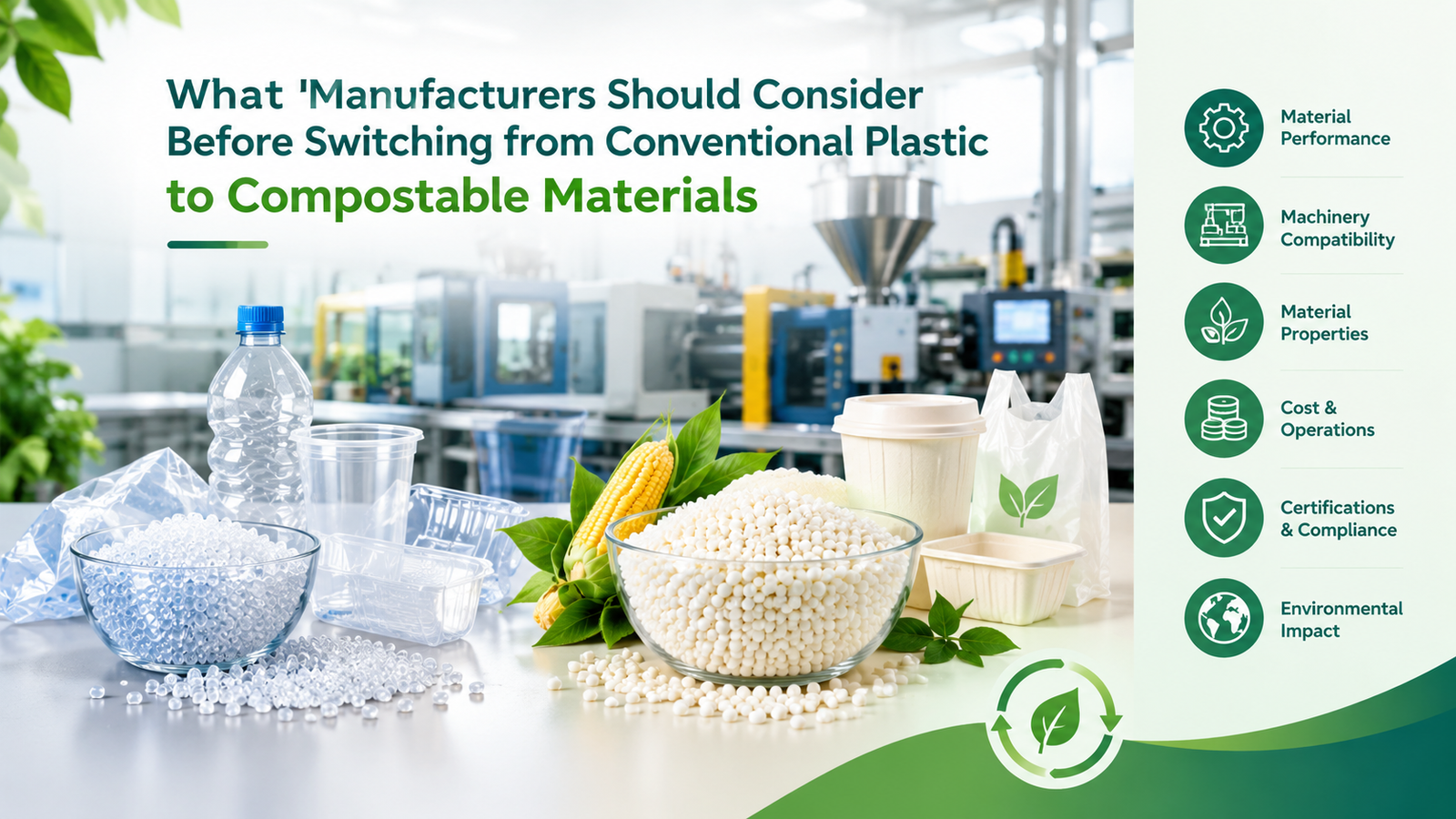
What Manufacturers Should Consider Before Switching from Conventional Plastic to Compostable Materials

The decision to transition an industrial manufacturing line from conventional petrochemical plastics to compostable materials is a milestone moment for any enterprise. Driven by shifting consumer preferences, impending regulatory bans on single-use plastics, and corporate ESG (Environmental, Social, and Governance) commitments, companies across the globe are re-evaluating their material portfolios. However, transitioning from synthetic polymers that endure for centuries to materials designed to return safely to the earth is a complex engineering and operational undertaking. Success requires careful strategic planning, thorough technical evaluation, and a clear understanding of supply chain realities.

Defining Compostability: Industrial vs. Home Composting Standards

One of the most critical preliminary considerations for manufacturers is understanding the precise end-of-life mechanism required for their products. Compostable materials are not a monolithic category; they are strictly engineered to degrade under specific biological conditions governed by international standards such as ASTM D6400 or EN 13432.

Production leaders must evaluate whether their target market has access to industrial composting infrastructure or if home-compostable formulations are necessary. Industrial compostable resins typically require controlled temperatures, moisture levels, and microbial activity found in municipal composting facilities, whereas home-compostable variants degrade safely in backyard compost bins. Misaligning the product’s end-of-life specification with regional waste management infrastructure can lead to consumer confusion and policy non-compliance.

Mechanical and Thermal Performance Compatibility

Conventional plastics like polyethylene, polypropylene, and polystyrene were optimized over decades to possess specific tensile strengths, impact resistance, and thermal thresholds. When substituting these with compostable biopolymers such as PLA blends or PHA, manufacturers must rigorously test mechanical compatibility.

Factors such as tensile elongation, heat deflection temperature, moisture barrier properties, and seal integrity under high-speed packaging lines must be analyzed. Expert partners like Deltora Biopolymers Pvt. Ltd. assist manufacturers in conducting thorough laboratory testing and pilot trials to ensure compostable compounds meet or exceed the performance benchmarks of legacy plastics without requiring complete overhauls of existing machinery.

Supply Chain Resilience and Raw Material Sourcing

Unlike petroleum derivatives derived from global oil refining networks, bio-based feedstocks are tied to agricultural yields, fermentation capacities, and regional biomass availability. Manufacturers must examine the resilience and traceability of their raw material supply chains before committing to large-scale production runs.

Evaluating supplier reliability, batch-to-batch consistency, and long-term price stability is essential. Partnering with established compounders like Deltora Biopolymers Pvt. Ltd. guarantees access to rigorously tested, high-grade compostable resins backed by robust quality assurance protocols, minimizing production downtime and mitigating supply chain vulnerabilities.

Regulatory Landscape and Certification Compliance

The sustainability claims made by manufacturing brands face intense scrutiny from regulatory bodies and consumer protection agencies worldwide. Greenwashing allegations carry severe financial and reputational penalties. Therefore, obtaining certified compostability credentials from accredited third-party laboratories is non-negotiable.

Manufacturers must ensure that their finished goods comply with regional labeling laws, heavy metal limits, and ecotoxicity testing. Designing packaging or manufactured goods with certified resins simplifies the regulatory approval process and builds unshakeable trust with eco-conscious consumers.

Cost Analysis and Total Value Assessment

A common hesitation among production managers is the initial material cost disparity between commodity plastics and specialized compostable resins. While raw material purchase costs for biopolymers may currently be higher due to scaling economics, a comprehensive total cost of ownership (TCO) evaluation reveals hidden savings.

Reduced extended producer responsibility (EPR) fees, avoidance of plastic packaging taxes, enhanced brand loyalty, and future-proofing against incoming regulatory bans all contribute to a favorable long-term financial ROI. Transitioning to compostable materials is an investment in business resilience.

Conclusion: A Strategic Roadmap for Sustainable Production

Switching to compostable materials is far more than a simple procurement swap; it is a holistic corporate evolution. By meticulously assessing performance metrics, infrastructure readiness, regulatory requirements, and supply chain partners, manufacturers can execute a seamless transition.

Embracing compostable innovation positions forward-thinking companies at the forefront of the modern green economy, transforming environmental responsibility into a lasting competitive advantage.

The Materials of Tomorrow: How Sustainable Innovation Is Redefining the Products We Use Every Day

Everyday products are built around materials. From packaging and shopping bags to agricultural products, household goods and consumer items, the materials selected during product development can influence performance, cost, manufacturing efficiency and environmental impact. As businesses face increasing pressure to reduce waste and use resources more responsibly, material innovation is becoming an important part of how products are designed for the future.

The materials of tomorrow are not simply about replacing conventional materials. They represent a broader shift towards renewable resources, compostable solutions, advanced composites, efficient formulations and application-specific development. These innovations can help industries rethink products from the beginning rather than waiting until waste has already been created.

Material Innovation Starts Before the Product Reaches Consumers

Consumers usually see a finished product, but its environmental journey begins much earlier. Raw materials must be sourced, processed and converted into usable forms before manufacturing can begin. Energy, water, transportation and production processes can all contribute to the overall resource footprint of a product.

For this reason, sustainable product development requires more than asking whether an item can be recycled. Businesses can consider where materials originate, how efficiently they are used, whether renewable alternatives are suitable and what happens when the product reaches the end of its useful life.

Smarter material selection can therefore become one of the most important opportunities to improve the environmental profile of a product from the earliest stage.

Why the Materials of Tomorrow Matter

The material selected for a product can influence strength, flexibility, weight, durability, processing requirements and potential end-of-life options. Choosing a material only because it is familiar or inexpensive may overlook opportunities for greater efficiency and environmental responsibility.

Innovation is giving manufacturers more choices. Compostable materials, renewable resources, advanced composites and improved formulations are creating possibilities for businesses seeking alternatives to conventional materials in suitable applications.

However, a newer material is not automatically a better material. The right solution depends on the application, sourcing, manufacturing process, required performance and end-of-life conditions. Responsible innovation requires looking at the complete product lifecycle instead of relying on a single sustainability claim.

Sustainable Innovation Can Reduce Waste at the Source

One of the strongest advantages of material innovation is its ability to address environmental considerations before waste is created. Better formulations can potentially reduce unnecessary material consumption while maintaining the properties needed for a particular application.

Research can help manufacturers develop materials with specific characteristics instead of relying on excessive quantities of a standard material. A packaging product may need strength and flexibility, while an agricultural application may require very different characteristics.

Deltora Biopolymers Private Limited is focused on developing compostable compounds, composites and tailor-made material solutions that explore more sustainable possibilities for different applications. This material-focused approach demonstrates how environmental considerations can become part of product development rather than being addressed only after disposal.

Renewable Resources Are Expanding Material Possibilities

One important direction in sustainable innovation is the use of renewable resources and agricultural residues. Materials that were previously viewed mainly as waste can potentially become useful inputs for new products through research, processing and advanced compounding.

This approach can help industries look at resources differently. Instead of treating every residue as something with no further value, businesses can explore whether suitable materials can be recovered, processed or incorporated into new solutions. Such innovation can support resource efficiency while creating additional value from existing materials.

The objective is not to assume that every renewable resource is automatically sustainable. Sourcing, processing, transportation, performance and end-of-life considerations all need to be evaluated. The strongest solutions are those that combine practical functionality with responsible resource use.

Packaging Is Being Reimagined

Packaging is one of the most visible areas where material innovation is changing everyday products. Packaging needs to protect products, support transportation and maintain usability, but it can also contribute to post-use waste.

Manufacturers are therefore exploring lighter designs, improved material efficiency, compostable alternatives and renewable inputs where appropriate. In some cases, the biggest improvement may come from reducing the amount of material required rather than simply replacing it.

Better packaging design can also eliminate unnecessary layers or components. This shows that sustainable innovation is not always about inventing a completely new material. It can also mean redesigning how existing materials are used.

From Agricultural Residues to New Material Opportunities

Innovation is also changing how industries view resources that were previously considered waste. Agricultural residues and other renewable resources can potentially become inputs for new material solutions through research, processing and advanced compounding.

Turning available residues into useful materials can support resource efficiency while creating additional value from materials that might otherwise be discarded or burned. Such approaches can contribute to a more circular way of thinking, where industries look for opportunities to use resources more effectively.

The objective should not be simply to find a substitute for a conventional material. The larger opportunity is to develop solutions that make sense from technical, economic and environmental perspectives.

Everyday Packaging Is a Major Area for Innovation

Packaging is one of the clearest examples of why material choices matter. Packaging protects products, extends shelf life and supports transportation, but it can also generate significant amounts of post-use material.

Businesses are therefore exploring ways to reduce packaging weight, improve material efficiency and identify suitable alternatives for specific applications. Compostable and renewable material technologies can become part of this transition where their performance and end-of-life conditions are appropriate.

Better packaging design can also reduce unnecessary layers or excessive material use. Sometimes sustainability does not require a completely new material; it may begin with using less material or designing the product more efficiently.

Performance Cannot Be Compromised

Environmental responsibility cannot come at the expense of product functionality. Materials still need to meet practical requirements such as strength, flexibility, durability, moisture resistance, processing performance and stability where applicable.

This is why research and development remain central to sustainable material innovation. Businesses need solutions that can operate within real manufacturing environments and deliver consistent results. A sustainable material that cannot meet application requirements is unlikely to achieve meaningful adoption.

The future therefore lies in finding a balance between environmental objectives and technical performance. Application-specific development can help manufacturers explore sustainable alternatives without assuming that environmental responsibility requires lower quality.

Smarter Manufacturing Makes Materials More Valuable

The material itself is only one part of the sustainability equation. Manufacturing processes also influence resource use. Inefficient production can result in material waste, inconsistent output and unnecessary consumption of energy and other resources.

Modern process controls, precision equipment, automation and improved material formulations can help manufacturers improve consistency and reduce avoidable losses. When businesses use resources more efficiently, sustainability can become connected with operational efficiency rather than being viewed only as an additional expense.

This is particularly valuable for industries operating at scale. Even modest improvements in material utilisation or production efficiency can become significant when repeated across large production volumes.

Customisation Can Create More Purposeful Products

Not every product requires the same material properties. Using a standard material for every application can sometimes lead to unnecessary resource use or performance compromises.

Customised material solutions allow manufacturers to focus on the specific requirements of their products. This can help them consider material properties, processing needs, cost expectations and environmental objectives together.

Deltora Biopolymers Private Limited follows a customer-focused approach to material development, highlighting how customised solutions can help businesses explore alternatives based on individual application requirements. Such development can support the transition towards materials that are more purposeful, efficient and environmentally conscious.

The Future Goes Beyond Recycling

Recycling remains an important part of waste management, but it should not be the only sustainability strategy. Some products are difficult to collect or separate, while some materials may not be suitable for repeated recycling. This makes prevention, efficient design and smarter material selection equally important.

The most effective approach can involve several strategies working together: reducing unnecessary material use, choosing suitable renewable or compostable alternatives, improving manufacturing efficiency, designing products responsibly and supporting appropriate end-of-life management.

By considering these factors together, businesses can address environmental impact at multiple stages instead of waiting until a product has become waste.

Consumers Are Influencing Material Innovation

Growing consumer awareness is encouraging companies to examine the materials behind everyday products. Customers increasingly want products that align with responsible resource use and reduced environmental impact.

Businesses are responding by investing in research, redesigning products and exploring new material technologies. This can create a cycle in which changing expectations encourage innovation, while innovation gives businesses more practical sustainability options.

Building the Products of Tomorrow

The products of tomorrow will be shaped by decisions made long before they reach consumers. Their sustainability story includes raw materials, manufacturing, transportation, product design, usage and end-of-life management.

Innovation is changing that story by giving industries new ways to think about materials and production. Instead of asking only how to manage waste, businesses can ask how to prevent unnecessary waste, use resources more efficiently and design products with sustainability considered from the beginning.

The future of sustainable manufacturing will not depend on one material, one technology or one waste-management method. It will come from combining better material choices with efficient production, responsible design and practical end-of-life strategies.

Ultimately, sustainable innovation is redefining the products people use every day. By making smarter material decisions before products reach consumers, industries can work towards reducing resource consumption while maintaining performance and commercial value. The materials of tomorrow will be shaped by research, responsible design and the ability to connect environmental goals with practical industrial requirements.

Renewable Resources Can Create New Opportunities

Another important direction in sustainable material innovation is the use of renewable resources and agricultural residues. Materials that were once viewed primarily as waste may offer opportunities for value creation through research, processing and advanced compounding.

This approach can support more efficient resource use while encouraging industries to think differently about available raw materials. Agricultural residues, for example, may potentially be incorporated into innovative composite solutions for suitable applications. Such developments can create additional value from existing resources and support efforts to reduce certain forms of waste.

The goal is not to assume that every alternative material is automatically sustainable. Instead, businesses need to evaluate sourcing, processing, performance, application and end-of-life considerations carefully. Smarter choices require a complete understanding of how a material fits into the broader product lifecycle.

Reducing Waste Before It Reaches the Recycling Stage

Recycling deals with materials after they have completed their primary use. Smarter material choices can help address waste earlier. Reducing excess packaging, improving material efficiency and selecting application-appropriate materials can potentially decrease the amount of waste generated in the first place.

Manufacturing innovation also plays a role. More precise formulations and better process control can help reduce material losses and production variations. When businesses use resources more efficiently, they can improve both environmental performance and operational efficiency.

This is an important reason why sustainability should not be treated as a separate department or final-stage activity. Material selection, product design, manufacturing and waste management should all be part of the same long-term strategy.

Customised Solutions Can Prevent Unnecessary Consumption

Different industries need different material properties. Using more material than necessary or selecting a solution that does not match the actual application can lead to inefficiency and waste.

Customised material development offers a smarter alternative. By focusing on the requirements of a specific product or manufacturing process, businesses can work towards materials with suitable properties rather than simply choosing a standard option.

Deltora Biopolymers Private Limited emphasises customer-specific and sustainable material development, reflecting the importance of matching innovation with real industrial needs. Tailor-made approaches can help manufacturers explore solutions that balance functionality, processing requirements, cost considerations and environmental goals.

The Future Will Be Built on Better Decisions

The next stage of sustainability will depend on more than recycling bins and waste collection systems. Recycling will continue to play a valuable role, but greater progress can come from making better decisions much earlier in the lifecycle of a product.

Industries will increasingly need to ask where materials come from, how efficiently they are used, whether alternatives can reduce unnecessary environmental impact and what happens after the product has served its purpose. Innovation in renewable resources, compostable materials, composites and efficient manufacturing can help businesses explore these questions in more practical ways.

Smarter material choices also create an opportunity to connect sustainability with business value. Reduced waste, improved resource efficiency and application-specific product development can support operational goals while helping companies respond to changing environmental expectations.

Conclusion

Beyond recycling, the future of sustainability starts with choosing materials more thoughtfully. The biggest opportunities may come from preventing unnecessary waste, improving resource efficiency and developing materials that are designed with their complete lifecycle in mind.

As research and technology continue to advance, industries have an opportunity to move towards a more intelligent approach to production. The focus should not simply be on dealing with waste after it is created. It should begin with asking whether better material choices can help reduce the problem from the start.

By combining innovation, responsible resource use and practical performance, businesses can create products that support both commercial needs and long-term environmental responsibility. That is why the future of sustainability starts not only with recycling, but with making smarter choices about the materials used every day.

Innovation Is Changing the Meaning of Performance

Performance remains essential for every industry. Materials and products must meet specific requirements related to strength, flexibility, durability, heat resistance, moisture resistance and usability. Sustainable alternatives can only achieve wider adoption when they are capable of performing effectively in real-world applications.

This is where material science and continuous research play an important role. Advanced formulations and specially developed material blends are helping manufacturers improve the functional properties of sustainable materials. Instead of simply replacing one material with another, innovators are designing solutions around the exact requirements of an application.

For example, packaging manufacturers may need materials with good strength and processing characteristics, while agricultural applications may require products designed for specific environmental conditions. Innovation allows manufacturers to develop more targeted solutions rather than relying on a single standard material for every purpose.

Deltora Biopolymers Private Limited is contributing to this approach by focusing on research, customer-specific development and sustainable material innovation. The company’s R&D efforts include developing compostable compounds and composites designed to help businesses move towards more environmentally responsible manufacturing while addressing practical performance requirements.

Smarter Production Can Help Control Costs

One of the biggest concerns surrounding sustainable innovation is cost. Businesses naturally need to consider raw material expenses, production efficiency, equipment requirements and long-term profitability before adopting a new solution.

Innovation can help address these concerns by improving the overall efficiency of the manufacturing process. Better material formulations may reduce unnecessary material consumption, while precise compounding and dosing can improve consistency and minimise production variations. Companies can also focus on developing materials that work effectively within existing manufacturing systems, reducing the need for major equipment investments.

Cost should also be viewed beyond the initial purchase price. A cheaper material that causes high wastage, inconsistent quality or operational difficulties may become more expensive over time. Similarly, a solution that improves process efficiency, reduces waste and supports changing environmental requirements can offer better long-term value.

The goal is not always to find the lowest-cost material. Instead, industries are increasingly looking for the best balance between product quality, operational efficiency and total lifecycle value.

Sustainable Materials Are Becoming More Practical

Environmental responsibility is no longer limited to a company’s public image. Customers, regulators and businesses are paying greater attention to how products are sourced, manufactured, used and managed after disposal.

Innovation in renewable and compostable materials is creating new opportunities for industries that want to reduce their dependence on conventional single-use plastics. Modern sustainable materials are being developed for a variety of applications, including packaging, agriculture, healthcare, retail, logistics and consumer products. Deltora’s stated focus on compostable materials, tailor-made solutions and nature-friendly alternatives reflects how material innovation is being used to support this transition.

However, environmental responsibility should involve more than simply changing the final material. Businesses can also improve sustainability by reducing production waste, using resources more efficiently, exploring agricultural residues and designing products with their complete lifecycle in mind.

This broader approach can create a stronger connection between environmental goals and business performance.

Turning Waste Into Valuable Resources

Another important area of innovation involves finding productive uses for materials that were previously considered waste. Agricultural residues, industrial by-products and renewable resources can potentially become part of new material solutions through advanced processing and research.

This approach can provide multiple benefits. It may reduce the environmental impact associated with waste disposal while creating additional value from available resources. At the same time, it encourages industries to think more carefully about resource efficiency and circular production.

Deltora Biopolymers Private Limited highlights the development of certain innovative composites using agricultural residues, with the aim of reducing density and cost while helping address pollution associated with agricultural waste burning. This demonstrates how research can potentially connect economic efficiency with environmental responsibility rather than treating them as competing priorities.

Customisation Helps Avoid Compromise

Every industry has different requirements. A food packaging application does not face the same challenges as an agricultural product or a logistics solution. As a result, innovation increasingly focuses on customisation.

Tailor-made material solutions can help businesses select properties based on their actual manufacturing and product needs. This may help avoid overengineering, unnecessary material usage and unsuitable product designs. By developing solutions around specific applications, manufacturers can focus resources where they create the greatest value.

Customer-driven innovation is particularly important because practical industry challenges often lead to new research and product development opportunities. Continuous feedback between material developers and manufacturers can support better-performing, more efficient and more sustainable solutions.

Technology Supports Better Decision-Making

Digital tools and modern manufacturing technologies are also helping industries manage resources more effectively. Data can help identify material waste, monitor production consistency, improve quality control and support more informed decisions.

Automation and precision technologies can further reduce avoidable errors and improve efficiency. When combined with advanced materials, these improvements can help manufacturers achieve more consistent output while reducing unnecessary consumption.

Innovation, therefore, is not only about inventing a completely new product. It can also involve improving an existing process, refining a material formulation or finding a more efficient way to use available resources.

Building a More Responsible Industrial Future

The industries that succeed in the future will need to balance commercial goals with growing environmental expectations. Performance cannot be ignored, because products must remain reliable. Cost cannot be ignored, because businesses must remain competitive. Environmental responsibility cannot be ignored, because long-term industrial growth depends on better resource management and reduced environmental impact.

Innovation is helping bring these priorities together. Through advanced materials, efficient manufacturing, customised product development, waste reduction and continuous research, industries can move away from the idea that sustainability always requires sacrificing quality or profitability.

The path forward will require collaboration between researchers, manufacturers, businesses and consumers. As technology continues to evolve, industries will have more opportunities to create products that perform effectively, make economic sense and support a more responsible approach to production.

Ultimately, true innovation is about creating smarter solutions for real challenges. By balancing performance, cost and environmental responsibility, industries can build stronger businesses while contributing to a cleaner and more sustainable future.

Certified Compostable Materials in India Trusted Solutions for Eco-Friendly Manufacturing

As the global economy increasingly shifts toward sustainability, businesses across industries are rethinking their material choices. From packaging to consumer goods, the push for eco-friendly alternatives has never been stronger. In this transformative era, certified compostable materials in India are emerging as a game-changer, enabling manufacturers to align environmental responsibility with product innovation.

These materials are designed to break down naturally in composting environments, leaving no toxic residue behind. More importantly, certification ensures that these products meet stringent environmental and safety standards. India, with its rapidly growing focus on sustainability and circular economy models, is witnessing an impressive rise in demand for such certified alternatives.

What Are Certified Compostable Materials?

Certified compostable materials are biodegradable substances that decompose completely into natural elements like carbon dioxide, water, and biomass within a specific period under composting conditions. The key difference between “biodegradable” and “certified compostable” is that certification validates performance under standardized conditions. These certifications—such as those provided by BIS, TUV Austria, or OK Compost—ensure the material meets global environmental standards.

In the Indian context, the Central Pollution Control Board (CPCB) and the Bureau of Indian Standards (BIS) regulate these certifications. A certified compostable product in India must meet the IS/ISO 17088 standards for compostability and biodegradability.

Why Manufacturers Are Switching to Compostable Materials

  1. Regulatory Compliance
    With rising environmental concerns, India has implemented strict regulations against single-use plastic and non-recyclable materials. Manufacturers are now required to adopt alternatives that comply with environmental laws. Certified compostable materials provide a legally sound and forward-looking solution.
  2. Brand Image and Market Demand
    Modern consumers are increasingly conscious about what they purchase. Brands that align with sustainability trends attract more loyalty and visibility. Using compostable materials not only reduces environmental harm but also strengthens a company’s brand image.
  3. Better End-of-Life Management
    Unlike conventional plastics, certified compostable materials do not pollute soil or water. They offer better end-of-life value by contributing to compost systems and circular economies.
  4. Versatility and Innovation
    Compostable materials are now available in various forms—films, sheets, pellets, molded products, and more—making them suitable for industries such as food packaging, retail, agriculture, and personal care.

Key Sectors Benefiting from Certified Compostable Materials

  • Food Packaging: Compostable trays, containers, and wraps offer safe and eco-friendly alternatives for takeaways and deliveries.
  • Retail & E-commerce: Compostable courier bags, shopping bags, and garment packaging are becoming popular among fashion and lifestyle brands.
  • Agriculture: Mulch films and seed trays made of compostable material reduce microplastic contamination in soil.
  • Medical Supplies: Compostable gloves, syringes, and packaging for pharmaceuticals are making inroads in hospitals and healthcare units.

Deltora Biopolymers Private Limited – A Trusted Name in Compostable Innovation

One of the companies at the forefront of this green revolution is Deltora Biopolymers Private Limited. With a mission to replace harmful plastics with nature-based alternatives, Deltora specializes in high-quality certified compostable materials that meet international benchmarks.

The company offers a wide range of compostable solutions for food packaging, industrial use, agriculture, and retail. What sets Deltora apart is their commitment to product integrity, certified quality, and environmental sustainability. Their research-backed approach ensures that manufacturers get access to materials that perform reliably without compromising on eco-compliance.

Deltora Biopolymers Private Limited has also invested in educating manufacturers about sustainable practices, making it a valued partner for companies transitioning toward eco-friendly operations.

The Importance of Certification in Compostable Materials

Using compostable material is one step, but using certified compostable material is what truly matters. Certification ensures:

  • The product breaks down within a defined timeline.
  • No harmful substances are released during decomposition.
  • It’s safe for composting environments and human health.

Manufacturers using certified materials not only avoid regulatory risks but also gain consumer trust. In many sectors, especially exports and government tenders, certification is a mandatory requirement.

Challenges and the Way Forward

While the transition to compostable materials is accelerating, it does come with certain challenges:

  • Cost: Certified compostable materials may be slightly more expensive than conventional plastics.
  • Composting Infrastructure: India still lacks large-scale composting facilities in many cities.
  • Awareness: Both consumers and businesses need more awareness about composting benefits and correct disposal methods.

However, as government policies support sustainable development and the private sector embraces green technologies, these challenges are steadily being addressed.

How to Choose the Right Compostable Material Supplier

For manufacturers planning to go green, selecting the right supplier is critical. Here’s what to consider:

  • Look for suppliers with recognized certifications.
  • Evaluate product range and customization options.
  • Ensure the supplier offers support in documentation and regulatory compliance.
  • Ask for product test reports and samples.
  • Consider long-term supply capabilities and scalability.

Companies like Deltora Biopolymers have built their reputation on these very parameters, making them a preferred choice among forward-thinking manufacturers.

Final Thoughts

As the demand for sustainable manufacturing practices grows, certified compostable materials in India are paving the way for a cleaner, greener industrial ecosystem. Businesses that adopt these solutions today not only meet compliance standards but also secure long-term value through brand trust, customer preference, and environmental contribution.

With companies like Deltora Biopolymers Private Limited leading the charge, the path toward eco-friendly manufacturing in India is clearer than ever. By choosing certified compostable alternatives, manufacturers are not just reducing plastic pollution—they’re investing in a future that’s good for the planet and great for business.

The Rise of Compostable Materials India’s Contribution to a Waste-Free Future

The escalating environmental crisis driven by plastic pollution has spurred global innovation toward sustainable alternatives. Among the most promising solutions is the rise of compostable materials, which decompose naturally without leaving behind toxic residues. These materials are reshaping the way industries function, encouraging eco-conscious production, and enabling consumers to adopt greener habits. At the forefront of this revolution is India, a country rapidly gaining prominence for its commitment to sustainability and innovation in green materials.

With a growing number of businesses shifting toward environmentally friendly practices, Indian manufacturers of compostable raw materials have emerged as global leaders in producing versatile, biodegradable, and compostable solutions. Their work is transforming packaging, agriculture, food service, and even textiles, steering the nation—and the planet—towards a waste-free future.

Understanding Compostable Materials: A Natural Solution to Pollution

Compostable materials are derived from renewable resources like corn starch, sugarcane bagasse, wheat bran, bamboo, and other agricultural by-products. Unlike traditional plastics that linger in landfills and oceans for hundreds of years, compostable materials break down within weeks or months in industrial or home composting systems, returning nutrients to the soil.

Their growing popularity stems from a combination of environmental, legislative, and economic factors. Governments around the world, including India, are implementing stricter regulations on plastic use. At the same time, consumers are becoming more informed and vocal about their preference for sustainable packaging and products.

This perfect storm of pressure and opportunity has sparked unprecedented growth in India’s green manufacturing sector.

India’s Green Manufacturing Boom

India has always had a deep-rooted cultural reverence for nature and resource conservation. In recent years, this philosophy has intersected with technology and entrepreneurship to give rise to a new era of eco-innovation. Several Indian startups, SMEs, and large-scale manufacturers are now producing compostable raw materials that serve as viable substitutes for conventional plastic components.

The country’s vast agricultural landscape offers a steady supply of raw organic materials—corn husks, rice straw, banana fibers, and coconut shells, to name a few—which are now being re-engineered into compostable alternatives.

This resource abundance, combined with affordable labor and advanced research capabilities, gives India a significant competitive edge on the global stage. As a result, Indian manufacturers of compostable raw materials are not only catering to domestic demands but are also becoming key exporters to countries seeking sustainable alternatives for packaging, food containers, cutlery, and more.

Sectors Driving the Demand for Compostable Materials

  1. Packaging Industry: As e-commerce, retail, and FMCG sectors grow, there is a pressing need for sustainable packaging solutions. Compostable films, mailer bags, bubble wraps, and pouches made in India are now replacing single-use plastics across various supply chains.
  2. Food and Beverage: Restaurants, cafés, and delivery services are transitioning to compostable plates, bowls, cups, and cutlery. Indian manufacturers are responding to this demand with plant-based disposables that are durable, heat-resistant, and home-compostable.
  3. Agriculture: Compostable mulch films, seedling trays, and plant pots are transforming sustainable farming. These products naturally degrade into the soil, reducing labor costs and plastic waste in the fields.
  4. Healthcare and Hygiene: India is now seeing compostable sanitary napkins, diapers, and medical packaging solutions being developed for sensitive-use sectors. These innovations significantly reduce landfill load and support public health.
  5. Retail and Textiles: Compostable garment bags, retail carry bags, and product tags are replacing plastic counterparts, allowing fashion and textile brands to align with their sustainability goals.

Government Initiatives Supporting Compostable Alternatives

The Indian government has played an instrumental role in supporting the rise of compostable materials. With nationwide bans on single-use plastics and growing incentives for green startups, the ecosystem is conducive to sustainable innovation.

Agencies like the Bureau of Indian Standards (BIS) and the Central Pollution Control Board (CPCB) have introduced clear guidelines and certification systems for compostable products, ensuring trust and quality assurance in the market.

Furthermore, India’s focus on circular economy principles—emphasizing reuse, recycling, and regeneration—perfectly aligns with the ethos of compostable materials. Programs under the Ministry of Environment, Forest and Climate Change (MoEFCC) continue to push public-private partnerships that boost eco-conscious manufacturing.

Challenges and the Way Forward

Despite remarkable progress, compostable materials face several challenges. Limited industrial composting infrastructure and consumer awareness often hinder proper disposal. If not composted correctly, these materials can end up in landfills where they may not decompose efficiently.

Another challenge lies in the cost factor. Compostable materials, although decreasing in price with scale, are still often more expensive than their plastic alternatives. However, as technology improves and economies of scale are achieved, affordability is expected to increase significantly.

To overcome these hurdles, collaborative efforts are essential. Public education campaigns, stronger waste segregation systems, and expanded composting facilities must be prioritized.

Global Recognition and Export Potential

India’s momentum in the compostable material space has not gone unnoticed. Many international companies are sourcing sustainable materials from India to meet their corporate responsibility targets. From compostable grocery bags shipped to Europe to biodegradable packaging used by global fashion houses, Indian innovations are making a global impact.

By aligning with international environmental standards and offering high-quality, scalable products, Indian manufacturers of compostable raw materials are poised to lead the world toward a more sustainable, plastic-free future.

Final Thoughts

The rise of compostable materials marks a significant turning point in humanity’s quest for environmental sustainability. India’s contribution to this movement—through resourceful innovation, sustainable manufacturing, and cultural mindfulness—is both impressive and inspiring.

As more industries and consumers recognize the urgency of eco-conscious choices, the role of Indian manufacturers of compostable raw materials will become increasingly vital. Their dedication to creating biodegradable, planet-friendly alternatives is not just helping reduce plastic pollution—it’s building the foundation for a cleaner, greener, and waste-free world.

Bioplastics and the Future How Indian Companies Are Driving Sustainable Change

The future of sustainable living hinges on innovation, and one of the most transformative materials driving that change is bioplastics. As the world grapples with the consequences of excessive plastic usage—from marine pollution to overflowing landfills—bioplastics offer a compelling alternative: materials that serve the same purpose as conventional plastic, but with a far smaller environmental footprint.

Among the nations pioneering this shift, India stands out as a rising force. Fueled by its vast agricultural resources, growing environmental awareness, and increasing demand for eco-friendly alternatives, Indian companies are emerging as key players in the global green economy. At the heart of this revolution are sustainable bioplastics suppliers in India, who are playing a pivotal role in shaping the future of materials, production, and consumer habits.

Understanding Bioplastics: A Green Innovation

Bioplastics are derived from renewable biomass sources such as corn starch, sugarcane, cassava, and even algae. Unlike traditional plastics made from fossil fuels, bioplastics are designed to be biodegradable or compostable, reducing their long-term impact on the environment.

These materials can be engineered to match the strength, flexibility, and functionality of petroleum-based plastics, making them a viable substitute across multiple industries—from packaging and textiles to agriculture and electronics.

But the real game-changer is not just the switch from one material to another—it’s the commitment to an entirely new approach to production, consumption, and disposal. This is where India’s sustainability-driven manufacturing sector comes in.

India’s Commitment to Bioplastic Innovation

India has witnessed a surge in green startups and established manufacturers investing in research and development of bioplastics. The government’s nationwide ban on single-use plastics, combined with a rising eco-conscious consumer base, has created fertile ground for innovation.

Indian manufacturers are no longer just meeting local demand—they’re exporting eco-friendly materials and finished bioplastic products to markets across Europe, the US, and Southeast Asia. This success is driven by a powerful combination of cost-effective production, resource availability, and technological expertise.

Sustainable bioplastics suppliers in India are tapping into the country’s abundance of agricultural waste to produce raw materials for bioplastics. Corn, sugarcane bagasse, and rice husks are being turned into biodegradable packaging, disposable tableware, agricultural films, and more. These innovations not only reduce plastic dependency but also create value from agricultural by-products that would otherwise go to waste.

Key Sectors Benefiting from Bioplastic Adoption

India’s bioplastics boom is benefiting multiple industries:

  • Packaging Industry: With e-commerce and retail expanding rapidly, the demand for eco-friendly packaging is at an all-time high. Indian companies are now producing bioplastic wraps, pouches, and containers that are durable, printable, and compostable.
  • Food & Beverage: Restaurants and food brands are replacing polystyrene trays and PET containers with plant-based alternatives. This not only meets customer expectations for sustainability but also helps brands comply with food safety and plastic ban regulations.
  • Agriculture: Biodegradable mulch films and plant pots made from bioplastics are gaining traction in Indian agriculture. These products enrich the soil as they decompose, eliminating the need for plastic cleanup and improving land health.
  • Healthcare: Bioplastic syringes, gloves, and packaging are being tested and introduced in medical settings where hygiene is crucial but sustainability is often neglected.

Challenges on the Road Ahead

Despite the progress, the journey is not without obstacles. Bioplastics remain more expensive to produce than traditional plastics, limiting accessibility for smaller businesses. Infrastructure for composting or industrial degradation is still lacking in many parts of the country, leading to improper disposal.

Education and awareness are also critical. Consumers often confuse “biodegradable” with “safe to litter,” which can result in misplaced waste. Indian manufacturers, along with policymakers, are working to bridge these gaps through certification standards, clear labeling, and awareness campaigns.

India’s Competitive Edge in the Global Market

One of India’s strongest advantages in the bioplastics space is its low-cost manufacturing ecosystem combined with a high level of customization and innovation. Unlike other countries where bioplastic production might be limited to niche products, Indian manufacturers are offering scalable, affordable, and diverse solutions.

Moreover, international interest is growing rapidly. Countries with stringent plastic bans are turning to India for sourcing high-quality, sustainable alternatives. In this export-oriented model, Indian suppliers not only help global businesses meet their environmental goals but also boost the domestic economy through green growth.

Leading sustainable bioplastics suppliers in India are partnering with global corporations, research institutions, and NGOs to expand their capabilities and improve their technology. With continued investment and policy support, India is poised to become a global hub for bioplastic innovation in the coming decade.

The Path Forward: Circular and Sustainable

As the bioplastics industry evolves, the next step is to create a fully circular system—where materials are designed to return safely to the earth without polluting ecosystems. Indian companies are already exploring this through closed-loop manufacturing, smart packaging solutions, and integration with composting infrastructure.

In tandem with these efforts, startups and SMEs are contributing to the democratization of bioplastic usage by offering affordable, accessible products for rural and urban markets alike. This grassroots engagement ensures that sustainability isn’t just a luxury for elite consumers, but a shared responsibility across society.

Final Thoughts

The future of bioplastics is not only bright—it’s necessary. As the world pushes towards sustainable development goals, countries like India are proving that large-scale change is possible with the right blend of innovation, policy, and purpose.

By embracing agricultural by-products, investing in clean technology, and fostering global partnerships, Indian companies are leading the charge toward a plastic-free future. Thanks to the dedication of sustainable bioplastics suppliers in India, the dream of a greener, cleaner tomorrow is no longer a distant vision—it’s happening now.

Compostable Materials in India Leading the Way in Sustainable Manufacturing

In recent years, the need for sustainable alternatives to conventional plastic has grown exponentially. With increasing environmental concerns and the push for a greener planet, compostable materials have emerged as a promising solution. India, as one of the largest producers of eco-friendly products, is at the forefront of this sustainable revolution. Several compostable materials manufacturers in India are paving the way for an environmentally responsible future by developing innovative, biodegradable solutions.

Understanding Compostable Materials

Compostable materials are those that break down naturally into organic matter, leaving no toxic residue behind. Unlike traditional plastics, which take hundreds of years to decompose, compostable materials decompose within a few months under the right conditions. These materials are derived from natural substances like cornstarch, sugarcane, and cellulose, making them a viable alternative for packaging, disposable cutlery, and more.

India’s Growing Role in Compostable Material Manufacturing

India has become a hub for sustainable innovation, particularly in the field of compostable materials. The government’s stringent policies on plastic use, coupled with rising consumer awareness, have accelerated the demand for eco-friendly solutions. As a result, compostable materials manufacturers in India are investing in research and development to create high-quality, durable, and sustainable products.

Key Sectors Driving Compostable Material Adoption

  1. Food Packaging Industry: The food packaging sector is one of the largest consumers of compostable materials. Many Indian manufacturers are producing biodegradable food containers, straws, and cutlery to replace single-use plastics. This shift not only benefits the environment but also caters to the growing demand for sustainable dining solutions.
  2. Retail and E-Commerce: With the boom in online shopping, packaging waste has surged. Indian companies are addressing this issue by offering compostable mailers, bubble wraps, and carry bags that decompose naturally, reducing the carbon footprint of e-commerce businesses.
  3. Agriculture: Farmers are increasingly adopting compostable mulch films, bags, and seedling trays to enhance crop yield without harming the soil. These materials help retain soil moisture, suppress weed growth, and decompose harmlessly post-harvest.
  4. Healthcare and Medical Industry: The healthcare sector is adopting biodegradable gloves, aprons, and packaging solutions to minimize medical waste. Compostable alternatives are not only safe for the environment but also for human health.

Benefits of Using Compostable Materials

  1. Eco-Friendly and Sustainable: Compostable materials significantly reduce environmental pollution by breaking down into organic matter without releasing harmful toxins. This helps in reducing landfill waste and ocean pollution.
  2. Reduces Carbon Footprint: Manufacturing compostable materials requires fewer fossil fuels compared to conventional plastic production, making them a more sustainable option.
  3. Supports Circular Economy: Since compostable products return to the earth as nutrients, they contribute to a circular economy where resources are reused and recycled instead of discarded.
  4. Compliance with Government Regulations: India has imposed strict bans on single-use plastics in many states. Businesses that switch to compostable materials can avoid penalties and align with sustainability regulations.

Challenges in the Compostable Material Industry

Despite the rapid growth, there are several challenges that manufacturers face:

  • Higher Production Costs: The raw materials and technology required to produce compostable materials are costlier than traditional plastic.
  • Limited Consumer Awareness: Many consumers are still unaware of the benefits of compostable materials, leading to slower adoption rates.
  • Composting Infrastructure: India lacks widespread industrial composting facilities, which are essential for processing these materials effectively.

Future of Compostable Materials in India

The future of compostable materials in India looks promising. With continued investment in research, better government support, and increased consumer awareness, compostable products will become more mainstream. Many Indian startups and established companies are expanding their production capacities and collaborating with global sustainability initiatives to accelerate the transition towards a greener future.

Final Note

India is playing a significant role in the global shift towards sustainability. The country’s compostable materials manufacturers are making remarkable strides in offering eco-friendly solutions across various industries. As awareness grows and technology advances, compostable materials will become the norm, replacing harmful plastics and contributing to a healthier planet. By supporting and adopting compostable alternatives, businesses and consumers alike can be part of this green revolution and help shape a sustainable future.